AI will not live in one place, but trust has to
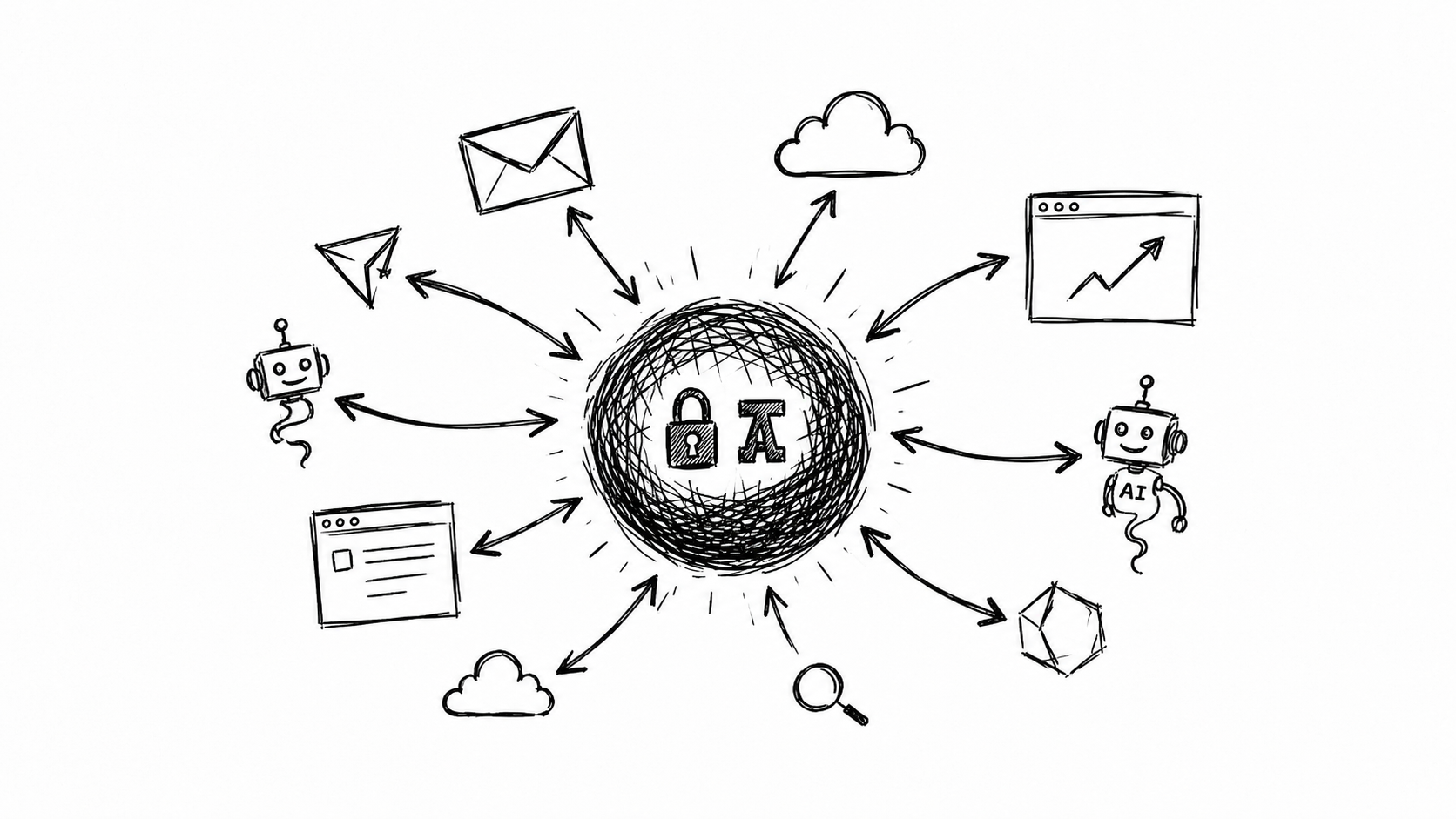
Enterprise AI is moving faster than enterprise governance. That is the contradiction most digital leaders are managing right now, whether they say it out loud or not.
AI is already showing up in the places where work happens. Browser assistants. Coding agents in the IDE. Local models on laptops. Custom agents wired through MCP. Chat-triggered workflow automations. AI features inside the platforms that run the business.
That is not going away, and it should not. People are finding leverage in the tools they already use.
The harder part is governance. No enterprise can review every prompt in every assistant, rebuild brand context inside every tool, or reconcile permissions across every agent, workflow, integration, and local experiment. Spend, audit, and risk cannot be treated as loose ends scattered across browser tabs and API keys.
This is the new AI architecture problem: work is becoming distributed, but trust still needs a home.
MCP gives developers access. Agent OS gives admins control.
Many organizations instinctively frame this as a choice. Open AI access or governed AI execution. Bring-your-own tooling or platform-contained AI. Pick a side.
That framing falls apart as soon as you look at how enterprise work actually happens.
Developers will use coding agents because those agents live inside their development workflow. Marketing teams will test assistants for campaign variants. Ops teams will chain external tools through automations. Agencies and partners will bring their own AI into client delivery. Some teams will run local LLMs for privacy or latency. Trying to force all of that into one product UI is not strategy. It is pretending.
At the same time, when AI touches regulated content, customer-facing experiences, brand, or compliance, ungoverned freedom becomes a real problem. Context fragments. Permissions get blurry. Spend spreads out. Audit trails weaken. The same flexibility that makes off-platform AI useful for exploration makes it risky as the default way to execute work.
The architecture that works accepts both realities. Use AI where the work happens. Govern AI actions where the business already manages the work.
Off-Platform AI is the reach layer
Off-platform AI is how enterprises get coverage across the systems that matter. Contentstack supports that through three practical surfaces: APIs, MCP, and agent skills.
Friendly APIs make the platform programmable for teams and partners. MCP makes Contentstack reachable from AI-native clients, IDEs, custom agent hosts, and external copilots without a pile of bespoke integrations. Agent skills give those external tools enough context to operate intelligently against Contentstack instead of treating the platform as a generic API to poke at through trial and error.
That combination is what makes external AI useful at enterprise scale. A coding agent can inspect content models through documented interfaces. An external assistant can request approved context through MCP. A custom agent can invoke an automation that already contains the workflow logic. In each case, the user stays in the tool they prefer.
This is the reach layer. It is where developer experimentation happens, where prototypes get built quickly, and where teams create their own orchestration across Contentstack and other systems. For technical teams that want flexibility, MCP plus skills plus APIs is the right surface.
What this layer does not do, and was never meant to do alone, is enforce enterprise governance. That is the other half of the architecture.
On-Platform AI is the trust layer
If MCP is free, the obvious question is why on-platform AI is worth paying for. The answer is simple: MCP and Agent OS are doing different jobs.
MCP is a protocol. Think of it as a USB port for AI. It standardizes how an external client plugs into Contentstack and calls capabilities. That is useful, and Contentstack should make MCP excellent.
But a USB port does not decide who is allowed to plug in, what they can do once connected, who pays for what they use, or what gets logged when something goes wrong. The operating system around the port handles that.
Agent OS is that operating system for AI inside Contentstack. It is the part that turns AI from a capability into something the business can actually run. Four gaps make the value clear.
The first gap is spend. MCP burns tokens. It does not bill them to a team, attribute them to a workflow, or warn an admin before a runaway agent eats through a quarter’s budget over a weekend. AI Credits inside Agent OS give per-user, per-agent, and per-workflow visibility into what AI costs, where it is used, and why. Admins can allocate credits, set thresholds, approve expensive workflows, and connect usage back to business value. Without that layer, AI spend becomes a string of small surprises that eventually turns into one big one.
The second gap is brand and content context. MCP gives an external client access to the API. It does not automatically give that client the brand voice profile, approved content rules, locale-specific tone, or editorial guardrails the business has spent years defining. Agent OS can, because it runs inside the platform where that context already lives. The difference shows up in the output. An MCP call against an API can produce technically correct content that still feels off-brand. An Agent OS workflow can use Brand Kit voice profiles and approved context by default.
The third gap is review and approval. MCP can change things. MCP does not review what changed. When AI suggests copy for a developer’s local prototype, that may be fine. When AI updates a regulated product description on a live entry, it is not. Agent OS can route AI-assisted changes through the same workflow stages, approval gates, and review surfaces that already govern human changes. The audit trail can show who acted, which agent was involved, what context was used, and what was reviewed.
The fourth gap is reusability. The most useful AI workflows in an enterprise are usually refined over weeks of trial and error. Without an operating layer, those workflows end up on someone’s laptop, in a personal prompt library, in a private GitHub repo, or in an agency folder. The organization pays for the learning but never really owns it. Agent OS turns agents, skills, and automations into governed assets that belong to the business. They can be scoped by permission, versioned, reused, and improved across teams.
None of these are protocol problems. They are operating-model problems, and they appear the moment AI moves from experimentation into production work.
That is what on-platform AI buys. Not a better chat window. A governed substrate for AI work that is permission-aware, brand-aware, reviewable, and economically visible.
Best-Fit guidance
The honest answer to “MCP or Agent OS?” is usually both, for different reasons.
MCP, agent skills, and APIs are the right fit for developer-led experimentation, rapid prototyping, external copilots and coding agents, bring-your-own orchestration across systems, and invoking approved automations from external clients. They give technical teams room to build their own AI experience.
Polaris, Agent OS, and AI Credits are the right fit for usage visibility, spend control, admin-managed governance, permission-aware AI actions tied to each user’s authentication context, brand-aware workflows that respect Brand Kit and approved content context, custom agents that run on demand or inside editing and workflow surfaces, and reviewable AI-assisted changes that are attributed and logged.
The pattern most enterprises land on is straightforward once it has a name. External AI gathers context through MCP and skills, requests action through governed capabilities, and hands work back into Contentstack workflows for review, approval, and publishing.
The reach layer expands what is possible. The trust layer makes it usable in the business.
There is also a practical efficiency angle that often gets missed in the governance conversation. On-platform AI does not start cold. Polaris benefits from a smart cache layer that sits between the agent and the Contentstack API, keeping a lightweight, automatically synced view of the space, content types, structure, and entries. Instead of running bulk discovery calls every time it needs to understand the environment, Polaris reads that pre-built context and makes a targeted API call only for the specific entry it actually has to act on. The result is fewer API calls, lower token consumption, and faster execution. Governance is the headline reason to run AI on-platform. Efficiency is the quiet one, and at enterprise volume it compounds quickly.
Conclusion
The tension between off-platform AI and on-platform AI is not a product category fight. It is an architecture question that every enterprise will answer, either deliberately or by accident.
Off-platform AI gives enterprises reach. It brings AI into the tools where people already code, plan, write, analyze, and automate. No platform vendor will out-build that ecosystem, and none should try.
On-platform AI gives enterprises trust. It brings AI into the systems where content, permissions, workflow, brand, and accountability already live. It turns AI activity into repeatable business capability.
Contentstack’s position is to connect those worlds: open access through APIs, MCP, and agent skills; governed execution through Agent OS, Polaris, and AI Credits.
The platforms that win this next phase will be open enough for the AI ecosystem and governed enough for enterprise operations.
AI will not live in one place. But trust has to.
On this page
Related articles
Building MCP Profile Hub part 2, one MCP server is the wrong abstraction
This article argues that a single, monolithic MCP server per platform is the wrong abstraction, especially for complex systems like Contentstack. Instead, it introduces managed profiles as the right unit of configuration, aligned to jobs, teams, or access boundaries rather than product catalogs. Each managed profile bundles a curated set of tools, Automations, and agents, enriched with account context, while still respecting individual user identities and permissions. Profiles can only narrow what a user can do, never expand their underlying platform permissions. This makes configurations easier to reason about, review, audit, and replicate across environments, and offers a scalable pattern for enterprise platforms with many roles and capabilities.
- Composable architecture
- AI engineering
- API design

Building MCP Profile Hub, part 1: Stop making the agent ask
Introducing MCP Profile Hub. I explain why enriching tool definitions with tenant-specific context dramatically improves agent performance. Instead of exposing generic CMS tools that force models to discover content types, environments, locales, and branches through multiple lookup calls, Profile Hub injects real account data directly into JSON Schemas as enums, defaults, and descriptions. This reduces tool calls, latency, and reasoning tokens while avoiding misleading examples and invalid defaults. The piece also covers the production engineering behind enrichment, how Automations and Agent OS agents are exposed as high-level deterministic tools, and why reusable HTTP-based tool definitions let teams run their own MCP runtimes. The core takeaway is that fewer, richer, context-aware tools beat large generic catalogs for real-world agent workflows.
- Composable architecture
- AI engineering
- API design

The Doer Economy - we are killing the translator class
This article argues that AI is collapsing the distance between vision and execution, ushering in a Doer Economy where the primary winners are those who can both imagine and build. The traditional corporate stack of translators (product managers, marketers, and multiple layers of management) is shrinking because executional tasks are increasingly handled by AI. Founders and CEOs are moving closer to product, validating ideas directly with AI-generated scaffolds and modern SaaS primitives. For individuals, the value has shifted from narrow, ticket-driven skills to end-to-end ownership, product thinking, and understanding users. The future belongs to people who ship, iterate quickly, and leverage AI and SaaS platforms to focus on business logic and user experience, rather than those who only manage the builders.
- Composable architecture
- AI engineering
- API design