Cursor's moat

Most of the Cursor Composer discussion got stuck on the part that is easiest to argue about. Is it Kimi? Is it a fine tune? Did Cursor say enough about the base model? Fair questions, especially because attribution matters, but I keep thinking the model drama is hiding the more interesting product story.
Cursor is sitting in the middle of software development while it happens.
That sounds obvious because, well, it is an IDE. But in AI terms it is a weirdly powerful position. A normal model lab can train on GitHub, docs, Stack Overflow, issues, examples, benchmarks, evals, and synthetic tasks. Useful stuff. But most of it is artifact data. It shows the code that survived, or at least the code that was published. It does not show the painful bit where the developer tried three approaches, accepted half a patch, threw away the abstraction, switched models because one got stuck in a loop, ran the tests, cursed at TypeScript, and finally shipped the boring version that worked.
I don’t mean “good” in the vague data moat sense that people use when they want to sound investor-ish. I mean there is a real difference between learning from a finished repository and learning from the sequence that produced it. The repository tells you what the answer looked like. The development session tells you what was tried, what failed, which edit the developer kept, and where human taste or local context overruled the statistically plausible answer.
The IDE sees the attempts
This is why Composer is interesting beyond the Kimi base model. Cursor says Composer 2 started from Kimi K2.5, then went through continued pretraining and large-scale reinforcement learning for agentic software engineering. The detail I care about is not just the training recipe. It is that Cursor tries to train and evaluate in something close to the same harness people use in the product.
That matters because coding agents are not chatbots with a repo attached. At least, they should not be. A coding agent has to work inside an environment. It needs file context, search, terminal access, diffs, tests, package managers, hidden conventions, and all the strange little signals that live in a codebase but never make it into the README. If you train or evaluate the model outside that environment, you are measuring a cleaner problem than the one developers actually have.
Cursor has the environment. More importantly, they have many models operating inside it.
A developer can run Claude, GPT, Gemini, Composer, and whatever comes next inside roughly the same product surface. Same editor. Same repo. Same task. Same developer making the final judgment. Over time, that gives Cursor a view that is hard to get from a benchmark alone. They can see where one model plans well but edits badly. They can see where another model writes decent code but gets lost after a failed test. They can see when the developer switches away from a model, when they accept a change, when they rewrite it by hand, and when the whole thing ends in something useful.
Shipping software is a better benchmark
That is not preference data in the old RLHF sense. “Which answer do you like better?” is a very different question from “which path got the work done?”
Software is unusually good at producing this kind of feedback because it has reality checks built in. The code compiles or it doesn’t. The test passes or it doesn’t. The developer keeps the change or deletes it. None of these signals are perfect, obviously. Plenty of bad code ships and plenty of good attempts die for unrelated reasons. But compared to asking someone to rank two polished paragraphs, a real development session gives you a much less decorative signal.
The environment is learning too
The obsession with “the model” feels too narrow. A lot of AI products still behave like wrappers. There is a model somewhere, a prompt, a bit of retrieval, a button, some tool calls if the team got ambitious. The product is treated as the delivery mechanism for intelligence that lives elsewhere.
Cursor points at a different shape. The product is not just where the model is used. It is where work is decomposed, attempted, corrected, accepted, rejected, and measured. The product starts to become part of the training system.
That shift is easy to miss if you look only at model cards and benchmark tables. It is obvious if you look at the workflow. A developer does not ask for “code” in the abstract. They ask for a change inside a messy system with history. The agent has to decide what context matters, which files to touch, when to inspect, when to run commands, when to backtrack, and when to stop. Those decisions are the work. The code is only the residue.
This is where many companies are still underthinking their AI strategy. They ask which model to use, whether to build an agent, whether to add MCP, whether to fine tune, whether to route between models. All fine questions. But I would start with a more boring one: does your product generate useful traces of work? Can you see what the user intended, which tools were used, what failed, and whether the outcome held up later?
This will not stay inside coding tools. Support platforms have resolution paths, escalations, reopened tickets, and satisfaction scores. CMSs have briefs, drafts, approvals, legal review, and performance data. None of that is as clean as a unit test, but it all describes work moving through a system.
The companies that understand this will build their AI products differently. They will care less about sprinkling chat boxes across the interface and more about making the work observable. They will design tools, permissions, review steps, and outcome tracking as part of one loop. Not because it looks good in a demo, but because the loop is how the system improves.
The moat is the loop
That is the part of Cursor I find more interesting than the base model controversy. Kimi matters. The post-training and RL setup matter. But the bigger lesson is that Cursor has a front-row seat to millions of software tasks being attempted in the same place where developers already work.
On this page
Related articles
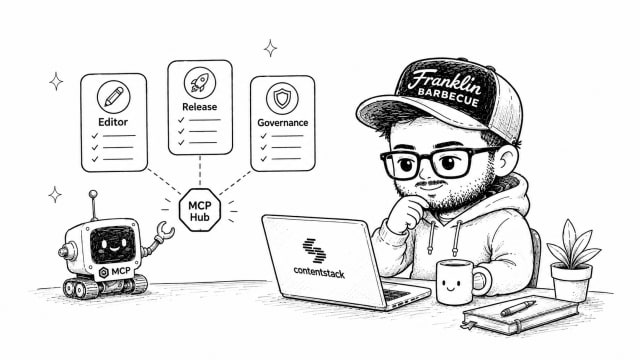
Building MCP Profile Hub part 2, one MCP server is the wrong abstraction
This article argues that a single, monolithic MCP server per platform is the wrong abstraction, especially for complex systems like Contentstack. Instead, it introduces managed profiles as the right unit of configuration, aligned to jobs, teams, or access boundaries rather than product catalogs. Each managed profile bundles a curated set of tools, Automations, and agents, enriched with account context, while still respecting individual user identities and permissions. Profiles can only narrow what a user can do, never expand their underlying platform permissions. This makes configurations easier to reason about, review, audit, and replicate across environments, and offers a scalable pattern for enterprise platforms with many roles and capabilities.
- Composable architecture
- AI engineering
- API design

Building MCP Profile Hub, part 1: Stop making the agent ask
Introducing MCP Profile Hub. I explain why enriching tool definitions with tenant-specific context dramatically improves agent performance. Instead of exposing generic CMS tools that force models to discover content types, environments, locales, and branches through multiple lookup calls, Profile Hub injects real account data directly into JSON Schemas as enums, defaults, and descriptions. This reduces tool calls, latency, and reasoning tokens while avoiding misleading examples and invalid defaults. The piece also covers the production engineering behind enrichment, how Automations and Agent OS agents are exposed as high-level deterministic tools, and why reusable HTTP-based tool definitions let teams run their own MCP runtimes. The core takeaway is that fewer, richer, context-aware tools beat large generic catalogs for real-world agent workflows.
- Composable architecture
- AI engineering
- API design

Claude Desktop MCP lifecycle is broken
Claude Desktop currently launches duplicate local MCP stdio servers for a single configuration, causing two independent OAuth flows, extra browser tabs, and unnecessary resource usage. The bug is masked once credentials are cached, so it silently persists in production while still spawning two processes every time. This is not an mcp-remote or external service issue but a host-level lifecycle problem, likely caused by overlapping legacy and new MCP managers and poor observability for one of the processes. Workarounds like pre-authenticating with mcp-remote mitigate UX pain but do not fix the duplication. The article argues that open-source tools should not shoulder complex coordination logic just to survive a major desktop app’s sloppy process management.
- Composable architecture
- AI engineering
- Performance