The Mini Shai-Hulud supply chain backlash will create worse software
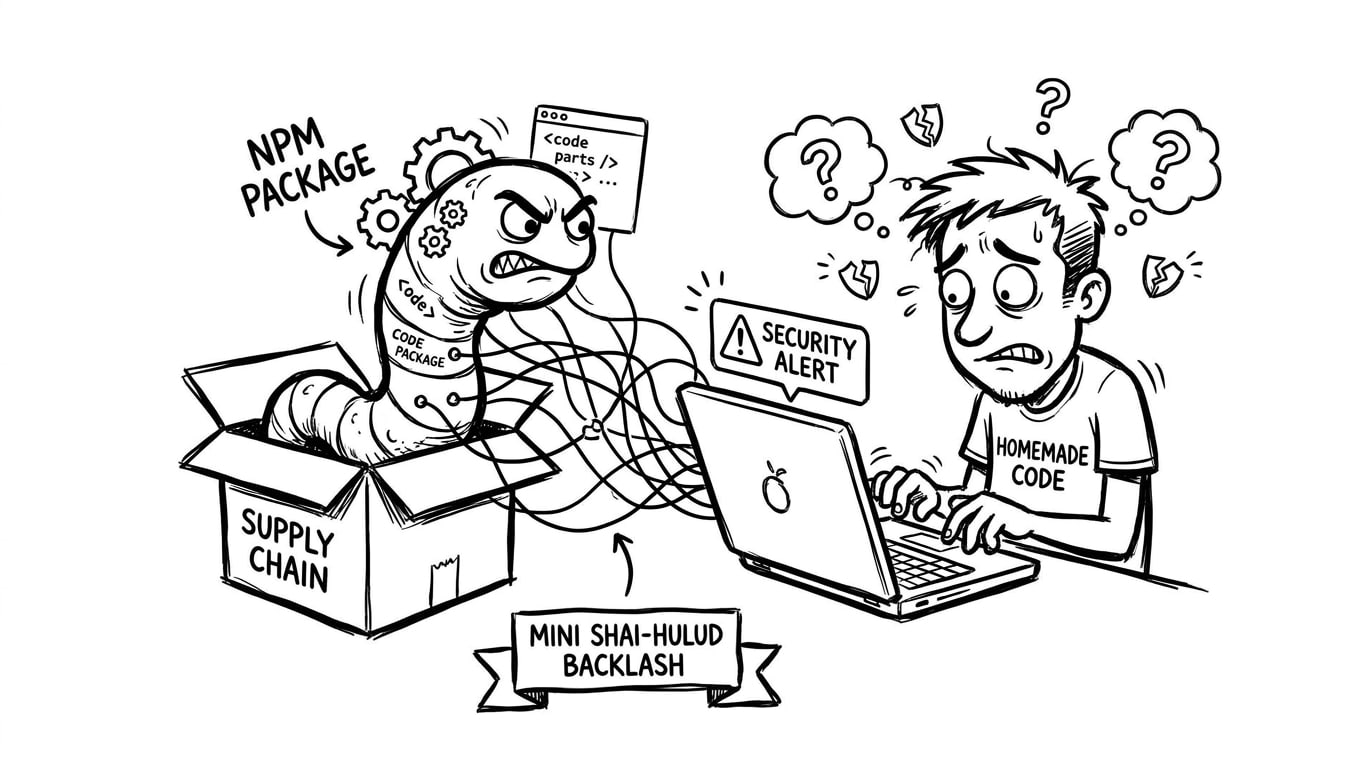
Supply-chain attacks are going to make teams write more of their own code. That sounds sensible until you realize a lot of that code will be vibe coded by people fleeing one security problem straight into another.
The NHS published an alert this week about a supply-chain attack affecting npm and PyPI packages across projects like TanStack, Mistral AI, UiPath, OpenSearch, and Guardrails AI. The details are ugly in the way modern security incidents are ugly. Malicious package versions. Install-time or import-time execution. GitHub tokens. npm tokens. CI/CD secrets. Cloud credentials. API keys. Lateral propagation when a compromised environment can publish more packages.
This is the stuff that makes developers stare at their package.json and wonder why half the internet is allowed to run code on their laptop during install.
I get the reaction. I feel it too. Every dependency starts to look like a tiny legal agreement with a stranger who can change their mind tomorrow. Every postinstall script looks suspicious. Every transitive package starts to feel like someone you invited into your house because another guest said they were cool.
The obvious response is dependency minimalism. Use fewer packages. Pin versions. Delay updates. Audit what enters the build. That is good engineering hygiene.
The dangerous response is homemade everything.
Fear changes the build-or-buy math
For years, the default advice was simple: do not build what you can import. Use the package. Use the SDK. Use the battle-tested library. Spend your time on the product.
That advice came from a reasonable place. Most teams should not write their own date library, auth system, Markdown parser, encryption helper, file uploader, schema validator, or SDK wrapper. Shared software exists because shared problems are expensive to solve well.
Supply-chain attacks damage that intuition. They make third-party code feel contaminated. The question changes from “why would we build this ourselves?” to “why are we letting this package run in our CI with secrets available?”
AI makes the reaction actionable. A developer can now ask a coding agent to replace a dependency with a local utility in an afternoon. Rewrite the SDK wrapper. Generate a tiny parser. Remove the package. Copy the relevant behavior. Add tests if anyone remembers.
That last part matters.
When building gets cheap, discipline becomes the scarce resource. The cost of creating code collapses, but the cost of understanding the code does not. The cost of maintaining it does not. The cost of securing it does not.
Internal code is still supply chain
There is a comforting lie inside the phrase “we built it ourselves.” It suggests control.
Sometimes that control is real. If a strong team replaces a bloated dependency with a small, well-tested internal module, fine. I like boring code. I like fewer moving parts. I like code a team can read in one sitting.
But internal code also has a supply chain. It has prompts. It has model output. It has copied snippets. It has generated tests that assert the implementation instead of the behavior. It has developers who do not fully understand the edge cases. It has future maintainers who will update it under deadline pressure.
The fact that code lives in your repository does not make it safer. It only changes who is responsible.
That responsibility is where many teams will struggle. They will remove a dependency because the dependency feels risky, then replace it with a vibe-coded local version that has no threat model, no fuzzing, no compatibility story, no security review, and no one assigned to maintain it.
The package manager risk goes down. The product risk goes up.
The Mini Shai-Hulud lesson
The NHS alert is worth reading because the attack is about trust boundaries more than bad packages. The malicious packages tried to harvest secrets from developer and CI environments. TanStack’s postmortem describes a chain involving GitHub Actions, cache poisoning, and OIDC trusted publishing. The malicious publish did not need a stolen npm token in the old-school sense. The attacker got code running where publishing authority existed.
That is the part that should make teams pause.
Modern development is full of invisible authority. CI can publish packages. GitHub Actions can mint tokens. Workflows restore caches. IDEs and AI tools can run hooks. Local directories like .vscode/ and .claude/ can become execution surfaces. Build systems are not passive plumbing. They are privileged software environments full of secrets.
So yes, scrutinize dependencies. But the deeper lesson is permission design. Why can this job publish? Why does this workflow have id-token: write? Why are secrets available during tests? Why does install-time code run in a place that can reach production credentials? Why do developer tools get to execute project-local hooks without anyone noticing?
If the answer is “because that was the default,” you found the actual problem.
Vibe coding will amplify the backlash
I have written before that vibe coding is useful when it is wrapped in boring production guardrails. Auth. Authorization. Secrets. Backups. Logging. Rate limits. Dependency health. Error handling. The stuff nobody demos because the app either has it or becomes a liability.
Supply-chain fear pushes directly against that discipline. It creates urgency. Urgency creates shortcuts. AI makes the shortcut look productive.
A team sees a compromised package in the news. Someone opens a PR called “remove risky dependency.” The agent writes a local replacement. The tests pass because the tests were generated from the happy path. The diff removes 14 packages, which feels like progress. Nobody asks whether the replacement handles malicious input, Unicode weirdness, timing issues, path traversal, token leakage, retries, partial failures, or backwards compatibility.
The code is now yours.
That should feel heavier than it does.
The next wave of security problems may come from this exact pattern. Thousands of small internal modules created as a reaction to dependency anxiety. Some will be fine. Many will be mediocre. A few will sit in sensitive paths and quietly do the wrong thing for years.
The better rule
The rule should be boring: own what makes your product specific, rent what is security-sensitive and generic, and review everything that crosses a trust boundary.
Build your own workflow surface. Build your own product-specific glue. Build the tiny thing that replaces a heavy dependency when the behavior is simple and the risk is low.
Be very careful when replacing auth, crypto, parsers, validators, sandboxing, permission checks, file handling, serialization, network clients, package publishing logic, and anything that touches secrets.
For third-party code, reduce the blast radius. Pin versions. Use lockfiles. Disable scripts where possible. Prefer packages with provenance, boring maintainership, and small dependency graphs. Run installs in environments that do not have production secrets. Scope CI permissions to the job that needs them. Treat publishing authority like production access because it basically is.
For internal AI-generated code, raise the bar. Write behavior tests before implementation. Ask for failure modes. Review the output like it came from a fast junior developer with no context. Document why the replacement exists. Assign ownership. Delete it when a better maintained option becomes safer.
The point is not to worship dependencies. The point is to stop pretending local code is magically trustworthy.
Concluding
Mini Shai-Hulud should make teams more serious about dependency hygiene, CI permissions, credential rotation, and package publishing workflows. It should not start a cargo cult where every external package gets replaced by AI-generated internal code.
The future probably has fewer dependencies. Good. Many projects have too many.
But the future also has more bespoke software, more generated code, more local utilities, more internal wrappers, and more teams maintaining things they used to import. That can be healthy if the engineering discipline rises with it.
If the discipline does not rise, we will trade one supply-chain problem for another.
Your npm package can be compromised. Your vibe-coded replacement can be worse.
On this page
Related articles

Ten AI security problems hiding in plain text
This article argues that AI security risks extend far beyond model jailbreaks and prompt engineering, into every piece of text an AI can read. Natural language now behaves like soft code, where logs, documentation, commit messages, wikis, support tickets, web pages, PDFs, and search results can all carry hidden instructions for agents. The author walks through ten concrete scenarios where ordinary text fields become attack surfaces, often with delayed or indirect activation through internal tools and multi agent pipelines. The core message is that information and instruction have blurred, and any text accessible to AI must be treated as part of the security model. Teams need to rethink access, editing rights, retrieval, and agent capabilities accordingly.
- Composable architecture
- AI engineering
- Cloud & infra

I will not log into your vibe coded app
Vibe coding has made it trivially easy to spin up apps that collect user data, handle logins, and store sensitive information. The problem is that most people building these apps have no idea how authentication, database security, or data protection actually work. Defaults on services like Supabase and Firebase are dangerously permissive, GDPR obligations are being ignored entirely, and users are handing credentials to apps built by people who have never heard of row level security. My personal rule now is simple. If it looks vibe coded and asks for username and password, I walk away.
- Composable architecture
- AI engineering
- Cloud & infra
Building MCP Profile Hub part 2, one MCP server is the wrong abstraction
This article argues that a single, monolithic MCP server per platform is the wrong abstraction, especially for complex systems like Contentstack. Instead, it introduces managed profiles as the right unit of configuration, aligned to jobs, teams, or access boundaries rather than product catalogs. Each managed profile bundles a curated set of tools, Automations, and agents, enriched with account context, while still respecting individual user identities and permissions. Profiles can only narrow what a user can do, never expand their underlying platform permissions. This makes configurations easier to reason about, review, audit, and replicate across environments, and offers a scalable pattern for enterprise platforms with many roles and capabilities.
- Composable architecture
- AI engineering
- API design